Part 1: The Rain and the Stranger
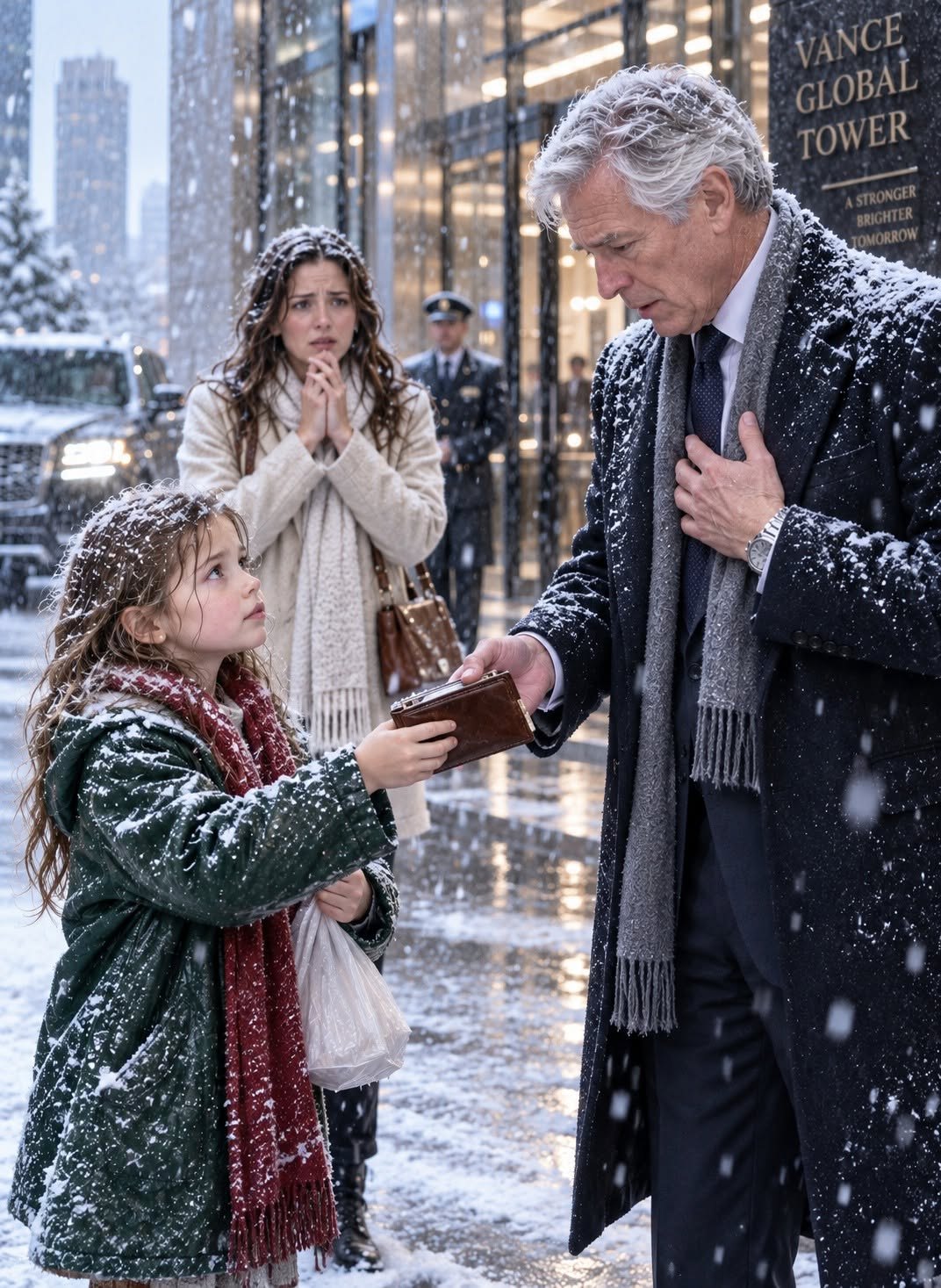
A little girl stood beneath the brutal Texas rain outside my skyscraper for nearly two hours, clutching my lost wallet to her chest and refusing to hand it to anyone but me. When I finally found her, I tried to give her several hundred-dollar bills as a reward. She looked at the money. Then she looked at me. And quietly said one word that would haunt me long after the rain stopped.
“No.” I was sixty-one years old. I owned four commercial high-rises in downtown Austin, had hundreds of employees, and had just walked out of the most important board meeting of my career after closing a million-dollar deal. I had everything money was supposed to buy. Except the one thing I had wanted for years. My daughter. Julia had stopped answering my calls three years earlier.
I told myself I was too busy to think about it. That evening, however, as I walked through the marble lobby toward the glass doors, I felt strangely tired. Not physically tired. Empty. One of my senior managers suddenly pointed toward the entrance. “Mr. Vance, security should probably deal with that child. She’s been standing there forever.” I turned.
A tiny girl stood outside in the storm. She couldn't have been more than eight. Her oversized green raincoat was completely soaked. Water dripped from her sleeves, her sneakers were saturated, and she was holding a thin plastic grocery bag against her chest as though it contained something far more valuable than anything inside my building. Our security chief approached me.
“I've tried bringing her inside three times. She refuses.” “Why?” “She says she has something that belongs to you.” I instinctively reached into my jacket. Nothing. My wallet was gone. I walked outside. The girl studied me carefully before pulling a battered brown leather wallet from the plastic bag. “Are you Arthur Vance?” “Yes.” She opened the wallet, looked at my driver's license, then compared the photograph with my face.
Only then did she hand it to me. “I found it beside a bench near the park.” Everything was still there. My credit cards. My building access card. More than six hundred dollars in cash. And then I saw the photograph. My daughter Julia, seventeen years old, laughing on a beach in Galveston. For a moment, the entire city seemed to disappear around me.
“Why didn't you give this to security?” I asked. The girl shrugged. “My mom says if you find something important, you give it back to the person who lost it. Not somebody else.” I looked down at her hands. Her fingers were bright red from the cold. “How long have you been standing here?” She lowered her eyes. “I don't know.” “One hour and fifty-two minutes,” the security guard answered quietly.
I stared at her. An eight-year-old child had stood in a Texas downpour for almost two hours just to return a wallet to a stranger. I took her inside. I ordered hot chocolate, but she wouldn't touch it until I counted every dollar in the wallet and showed her that nothing was missing. Then I pulled several hundred-dollar bills from my pocket. “You earned this.” She pushed the money back toward me.
“No.” I smiled, thinking she was simply shy. “It's okay. Take it.” She shook her head. “I don't need it.” That answer stopped me. I'd watched grown men fight over contracts worth millions. I'd seen executives destroy friendships over bonuses. I'd spent decades believing that money was the language everyone eventually understood. Yet this little girl, shivering in soaked sneakers, had just refused more money than her family might see in weeks.
“What’s your name?” “Rachel.” Her mother, she explained, was across the street interviewing for a job. The interview had started at three. It was almost six. Then a woman came running through the rain. She dropped to her knees beside Rachel, grabbed her freezing hands, and checked her face before even noticing me. “Do your fingers hurt?” “A little.” “Good.
That means you can still feel them.” Her name was Maria. And when I told her what Rachel had done, I expected gratitude. Instead, I saw fear. Then frustration. Then something else she tried desperately to hide. Shame. I offered them a ride home. Maria refused at first. But when Rachel began shivering again, she finally accepted. Their apartment was on Austin's east side.
It was small. Too small for two people carrying that much worry. The heater rattled constantly. The refrigerator contained almost nothing. On the kitchen counter sat a bag of rice, a few cans of beans, and three cans of soup. Then I noticed the papers pinned to the refrigerator. A final utility shutoff notice. And a thirty-day eviction notice. Maria saw me looking.
“I'm not asking you for money, Mr. Vance.” “I wasn't going to offer you money.” She looked surprised. “I wanted to ask about your interview.” She gave a tired laugh. Commercial cleaning subcontractor. Night shift. Minimum wage. But something about the way she said it bothered me. Because as Maria spoke, I began to realize that this woman wasn't someone who had always lived on the edge of poverty.
She had once managed entire cleaning crews. She understood contracts. She understood commercial buildings. She understood how businesses worked. And yet somehow, she and her daughter were four weeks away from losing their home. I looked at the eviction notice again. Then at Maria. “Tell me what happened.” Her expression changed. For several seconds, she said nothing.
Finally, she whispered: “You really don't want to know.” I had no idea that the answer to that question would eventually lead me back to my own daughter... and force me to confront something about my company that I had been blind to for years.