If they ever come back, do not trust anyone wearing a government badge.
PART 6 — Tyler Lost His House, His Money, and the One Thing He Thought Would Save Him
The warning on the letter changed everything.
Until that moment, I had believed this was a property dispute.
A greedy neighbor.
An illegal fence.
A pool built over my land.
But now I was staring at a document written almost fifty years ago, warning me not to trust anyone claiming authority over the vault beneath my property.
Rachel read the letter twice.
Then she looked at me.
“We need a specialist.”
“Who?”
“Someone who understands historical land titles and federal easements.”
“Why federal?”
She pointed to the old document.
“Because this wasn't just a private development.”
The communications vault had been connected to a government network.
And if the vault still contained anything sensitive, opening it without authorization could create a much bigger problem.
I nodded.
“What about Tyler?”
Rachel smiled.
“Tyler has his own problems.”
* * *
By Monday morning, the county issued several orders.
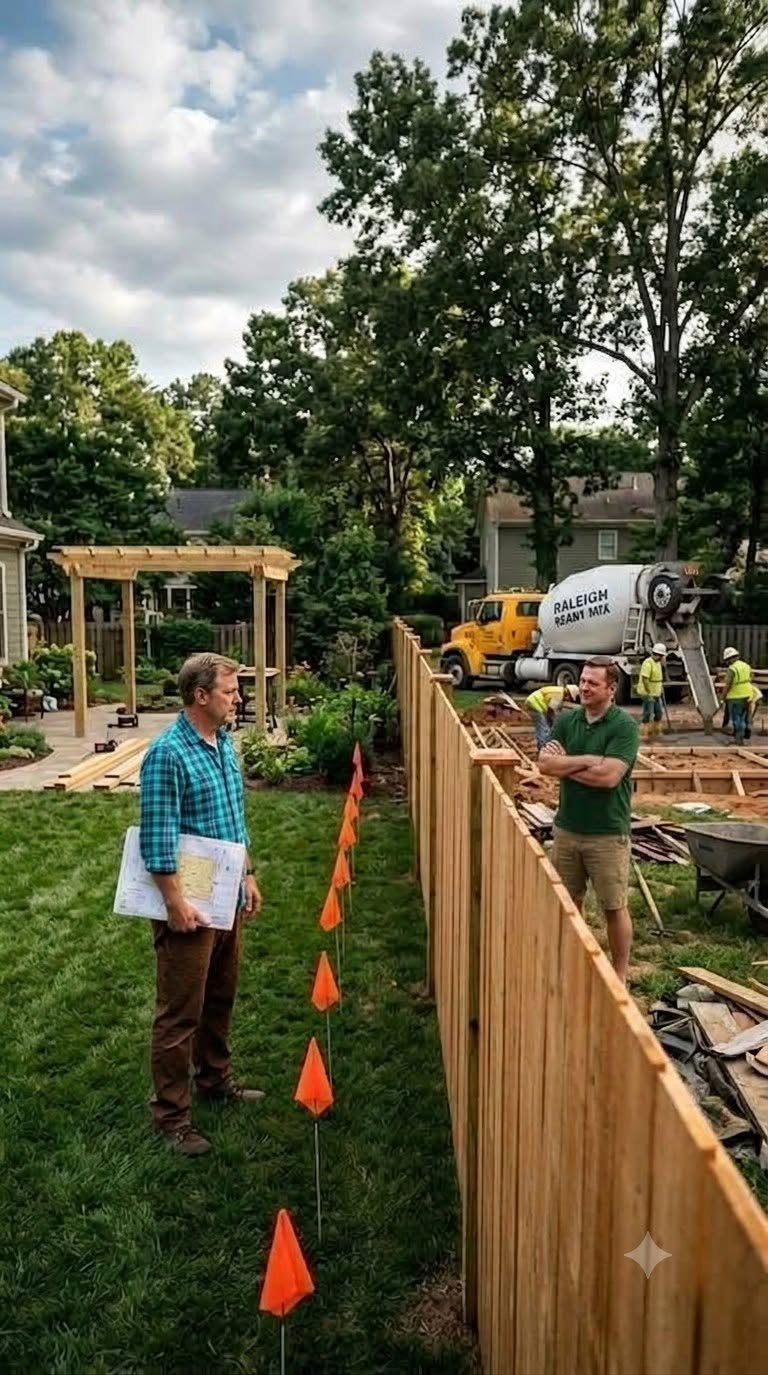
The fence had to be removed.
The pool deck crossing my property had to be demolished.
The retaining wall blocking the drainage easement had to come down.
And all construction on Tyler's property was suspended pending correction.
The estimated cost?
Over $180,000.
Tyler's dream backyard was now a financial disaster.
But that wasn't all.
The county also referred the matter to the building department because his permit drawings appeared inconsistent with the actual construction.
Then the utility company filed a formal notice.
The access corridor had to remain clear.
Tyler couldn't simply rebuild in the same location.
His lawyer contacted Rachel again.
This time, there was no offer.
There was only one question.
“Would your client accept a mutual release?”
Rachel laughed.
“No.”
* * *
A week later, workers arrived.
The fence came down.
Piece by piece.
The same fence Tyler had once told me could never move.
The same fence he had threatened to defend with the police.
Now it was being dismantled under a county order.
I stood beside the oak tree and watched.
Tyler came outside.
He looked exhausted.
“You're happy.”
I shook my head.
“No.”
“You ruined everything.”
“No.”
“You know how much I've lost?”
“I didn't make you build on my land.”
He looked toward the workers.
“I thought I could fix it.”
“You could have moved the fence eight weeks ago.”
He didn't answer.
Then he said:
“I was desperate.”
“Why?”
He looked at me.
“Because I was already in debt.”
I waited.
“The house was worth less than I paid.”
“Because of the utility corridor?”
He nodded.
“I thought if I built the perfect backyard, I'd increase the value enough to refinance.”
“So you used my land to make your property look bigger.”
“Yes.”
I looked at him.
“Why didn't you just tell me?”
He laughed bitterly.
“Would you have agreed?”
“No.”
“Exactly.”
I shook my head.
“You could have asked.”
“And you would have said no.”
“Yes.”
He looked toward the oak tree.
Then whispered:
“I never knew about the vault.”
I believed him.
For the first time, he looked less like an enemy and more like a man who had made one terrible decision after another.
But I still wasn't finished.
* * *
The investigation into the documents continued.
A title specialist discovered something remarkable.
The letter had been attached to an original deed.
The deed transferred the property to my grandfather.
Then to my father.
Then to me.
The asset mentioned in the letter was legally connected to the property.
Not to Tyler.
Not to the county.
Not to Hawthorne.
To my parcel.
But the records were incomplete.
The vault itself was still listed as an abandoned communications structure.
No active ownership claim had ever been recorded.
That meant nobody could simply take it.
Rachel explained:
“If there is something legally valuable inside, ownership will depend on what it is and whether any superior rights were reserved.”
“So we can't open it.”
“Not yet.”
“Who can?”
“That is what we're determining.”
* * *
Then something unexpected happened.
The federal government became involved.
Two officials arrived at my house.
They showed identification.
I remembered the letter.
Never trust anyone wearing a government badge.
I didn't let them inside.
Rachel spoke with them through the door.
After nearly an hour, they left.
The next day, we learned why.
The vault had been part of a classified communications network during the Cold War.
But the program had ended decades ago.
The government had abandoned the site.
However, certain records inside could still be subject to federal restrictions.
That meant the vault wasn't simply a treasure chest.
It was a legal minefield.
Then the officials made an offer.
They wanted to purchase the land containing the vault.
Rachel asked:
“How much?”
They offered $250,000.
I almost laughed.
“That's not enough.”
Rachel agreed.
“It's nowhere close.”
The officials left.
Three days later, another offer arrived.
$500,000.
Then $750,000.
Finally…
$1.2 million.
Rachel looked at me.
“They really don't want you opening that vault.”
I stared at the offer.
“Why?”
She shook her head.
“That is the question.”
* * *
Meanwhile, Tyler's financial situation collapsed.
His lender discovered the construction violations.
His property value dropped.
His refinancing application was denied.
The contractor sued him for unpaid invoices.
And the county issued additional penalties.
Within two months, Tyler had lost almost everything he had invested.
One afternoon, he came to my house.
He looked completely different.
No designer clothes.
No smug smile.
No expensive sunglasses.
Just a tired man standing on my porch.
“I owe you an apology.”
I opened the door.
“I'm listening.”
“I was wrong.”
“Yes.”
“I should have moved the fence.”
“Yes.”
“I should never have threatened you.”
“No.”
He looked down.
“I want to make things right.”
“How?”
“I'll pay for the damage.”
I studied him.
“Why?”
“Because you were right.”
I nodded.
Then Tyler said something unexpected.
“I also want to tell you what Martin never told you.”
“What?”
“The vault isn't what everyone thinks.”
I frowned.
“What do you mean?”
“It's not full of money.”
“I never thought it was.”
Tyler looked toward the oak tree.
“There's something else.”
“What?”
“Records.”
“Which records?”
He lowered his voice.
“Evidence.”
“Of what?”
He swallowed.
“Land fraud.”
I stared at him.
“How much?”
“Millions.”
“Who was involved?”
“Hawthorne.”
“Anyone else?”
He looked at me.
“People who later became judges.”
My stomach tightened.
“Politicians?”
“Yes.”
“Business owners?”
“Yes.”
“Government officials?”
He nodded.
Then he whispered:
“And one of them is still alive.”
I stared at him.
“Who?”
Tyler looked toward the street.
“I don't know.”
Then his expression changed.
He suddenly stepped backward.
“Someone's watching us.”
I turned.
A black SUV was parked across the street.
Its windows were tinted.
It drove away before I could see the driver.
I looked at Tyler.
“Was that them?”
He nodded.
“Probably.”
Then my phone buzzed.
A message from an unknown number.
STOP DIGGING.
I showed Tyler.
He became pale.
But before I could respond, another message arrived.
THE LAND IS YOURS.
Then a third.
THE VAULT IS NOT.
I looked at Rachel.
She read the messages.
Then she said:
“We need to open it legally.”
“Why?”
“Because whatever is inside may be the only thing protecting your ownership.”
That night, we obtained the final court order.
The vault could be opened under supervision.
An independent archivist would be present.
A federal representative would observe.
The county would document everything.
And I would be the legal property owner present during the inspection.
At sunrise, we stood beneath the old oak.
Workers removed the soil carefully.
A metal hatch appeared.
The same hatch my father had known about.
The same vault Tyler had risked everything trying to reach.
The lock was opened.
The door creaked.
Cold air rose from below.
We descended.
Inside were shelves.
Boxes.
Old tapes.
Maps.
Documents.
And one large steel cabinet.
Rachel opened the first file.
Her face changed.
“What?”
She handed me the document.
It was an original land registry.
But beneath my father's name was another signature.
A signature I recognized.
Tyler had once told me his father was a successful developer.
Now I knew why.
The signature belonged to Tyler Bennett's father.
And the document proved something impossible.
Tyler's family had known about the vault for decades.
But there was one final page.
It contained a list of properties.
Hundreds of them.
My property was number seventeen.
Next to it was a handwritten note:
DO NOT SELL.
And beneath that:
THE OWNER OF LOT 17 IS THE ONLY PERSON WITH LEGAL AUTHORITY TO ACCESS THE ARCHIVE.
I looked at Rachel.
She smiled.
Then she pointed toward the steel cabinet.
“Jason…”
“What?”
“There may be more.”
She opened the cabinet.
Inside was a single black box.
On top was a label.
HAWTHORNE — FINAL RECORDS.
I opened it.
Inside was a photograph.
My father was standing beside several men.
One was Tyler's father.
Another was Martin's former employer.
And the third man…
was the same man whose voice had called me.
At the bottom of the photograph was one sentence:
IF THIS ARCHIVE IS EVER FOUND, THE LAST LIVING PARTNER MUST BE STOPPED.
I stared at the face.
Then I recognized him.
He wasn't a stranger.
He wasn't some retired businessman.
He was the man who had given the county's first inspection report.
The inspector who had visited Tyler's property on the very first day.
The man who had told Tyler everything was fine.
And suddenly, I understood why Tyler had been so confident.
He hadn't believed the rules didn't apply to him.
He believed someone powerful would protect him.
But now that person was exposed.
And the documents in my hands could destroy an entire network that had survived for nearly fifty years.
I looked toward the vault entrance.
Rachel whispered:
“Jason…”
“What?”
“There are footsteps upstairs.”
We all turned.
Someone had entered the vault.
And a man's voice echoed down the stairs:
“You should have taken the million-dollar offer.”