PART 5 — Tyler Thought He Was Stealing My Land… But He Had Been Searching for Something Buried Beneath It
For the first time, I stopped thinking about Tyler as an arrogant neighbor.
He was something more calculated.
He had studied my property.
He had obtained old maps.
He had paid a surveyor.
He had deliberately moved the fence.
And now I knew he was looking for something underground.
Rachel asked Martin:
“What exactly did Tyler tell you?”
Martin looked uncomfortable.
“He said there was an old utility vault.”
“Where?”
“Near the oak tree.”
I looked at Rachel.
The oak tree.
The same place Tyler had been digging at two in the morning.
“What is in the vault?”
Martin shook his head.
“I don't know.”
“Did Tyler know?”
“He believed something was inside.”
“What?”
“Documents.”
Rachel frowned.
“What kind of documents?”
“Property records.”
That didn't make sense.
Why would anyone bury property records?
Martin continued.
“He said the documents proved the eastern part of the neighborhood belonged to an old development company.”
I stared at him.
“An old development company?”
“Yes.”
“Which one?”
Martin gave us a name.
Hawthorne Development Group.
I recognized it.
My father had mentioned that name years ago.
I had forgotten about it.
My father had worked for Hawthorne Development Group before he started his own electrical business.
Rachel immediately searched the county database.
Then she looked at me.
“Jason…”
“What?”
“Hawthorne owned a significant amount of land here.”
“How much?”
“Almost the entire neighborhood.”
I stared at the map.
“What happened?”
“They sold parcels individually.”
“Then what's the problem?”
Rachel zoomed in.
“One parcel wasn't properly released from the original development agreement.”
“Which parcel?”
She looked at me.
“Yours.”
I felt a chill.
“My house?”
“Yes.”
“What does that mean?”
“It means there may be a title issue.”
I shook my head.
“I've owned this property for eleven years.”
“And your title insurance?”
“Paid.”
She nodded.
“Then you're probably protected.”
“Probably?”
Rachel sighed.
“There's more.”
* * *
She obtained the original development documents.
Inside was a clause that had been overlooked for decades.
The eastern strip of my property contained a reversionary interest.
If certain conditions were triggered, ownership could potentially return to the original development entity or its successor.
But there was something even stranger.
The clause referred to a buried utility structure.
Rachel read it twice.
“This is unusual.”
“What?”
“The land was transferred subject to an underground service vault.”
“What kind?”
“Not ordinary utilities.”
She looked at me.
“It was designed as a communications vault.”
I frowned.
“For what?”
“Emergency communications.”
I laughed.
“That sounds like something from a movie.”
“It gets stranger.”
She showed me an old document.
The vault had been constructed in the 1970s.
It was connected to several government communication lines.
But according to later records, the vault was supposed to have been decommissioned.
“Was it?”
Rachel shook her head.
“I can't find proof.”
My stomach tightened.
“So there could be an active underground facility beneath my property?”
“Possibly.”
“And Tyler knows?”
“He seems to believe it.”
* * *
The next morning, we contacted the county archive.
An elderly records officer named Mr. Harris helped us.
When Rachel mentioned Hawthorne Development Group, his expression changed.
“You're asking about the old vault?”
I stared at him.
“You know about it?”
He nodded.
“My father worked for the county when it was built.”
“What was it for?”
“Emergency communications during the Cold War.”
I looked at Rachel.
Mr. Harris continued.
“It was never publicly discussed.”
“Why?”
“Security.”
“Is it still active?”
He hesitated.
“I don't know.”
“What happened to it?”
“It was supposed to be sealed.”
“Was it?”
He looked at the old records.
“There was a maintenance entry forty years ago.”
“Who accessed it?”
He pointed to the name.
Hawthorne Development Group.
Rachel asked:
“Was anything removed?”
Mr. Harris shook his head.
“The report says no.”
“What was stored there?”
“Backup communication equipment.”
“Anything else?”
He looked uncomfortable.
“Records.”
“What records?”
“Land acquisition documents.”
My heart started beating faster.
“Why?”
“Because Hawthorne had been involved in a massive land consolidation project.”
Rachel understood immediately.
“They may have stored original deeds there.”
Mr. Harris nodded.
“Possibly.”
* * *
That afternoon, Tyler's attorney requested another settlement meeting.
This time, he offered me $150,000.
Rachel almost smiled.
“We're not interested.”
The attorney frowned.
“You should consider this generous.”
Rachel leaned forward.
“Your client built structures across my client's property.”
“We're prepared to remove them.”
“Then remove them.”
“And we're willing to compensate him.”
“Why?”
The attorney hesitated.
I looked directly at him.
“What are you really buying?”
He didn't answer.
Rachel said:
“The strip isn't worth $150,000.”
“No.”
She smiled.
“But whatever is under it might be.”
The attorney's expression changed.
That was enough.
He knew.
I leaned back.
“Thank you.”
“For what?”
“For confirming we're asking the right question.”
The meeting ended immediately.
* * *
That evening, I returned home.
The sun was setting behind the oak tree.
I stood beside the old survey marker.
Then I noticed something.
A small metal plate.
It was partially buried beneath the roots.
I called Rachel.
She arrived with a flashlight.
We carefully examined it.
There was a faded symbol.
A serial number.
And beneath it:
HC-17
Rachel photographed it.
“I'll send this to the county.”
Ten minutes later, we received a response.
The number matched the old communications vault.
It was not supposed to be visible.
It was supposed to be buried.
Rachel looked at me.
“Someone exposed it recently.”
“Tyler.”
“Probably.”
We looked toward his backyard.
His pool had been shut down.
The fence was still standing.
But now I noticed something.
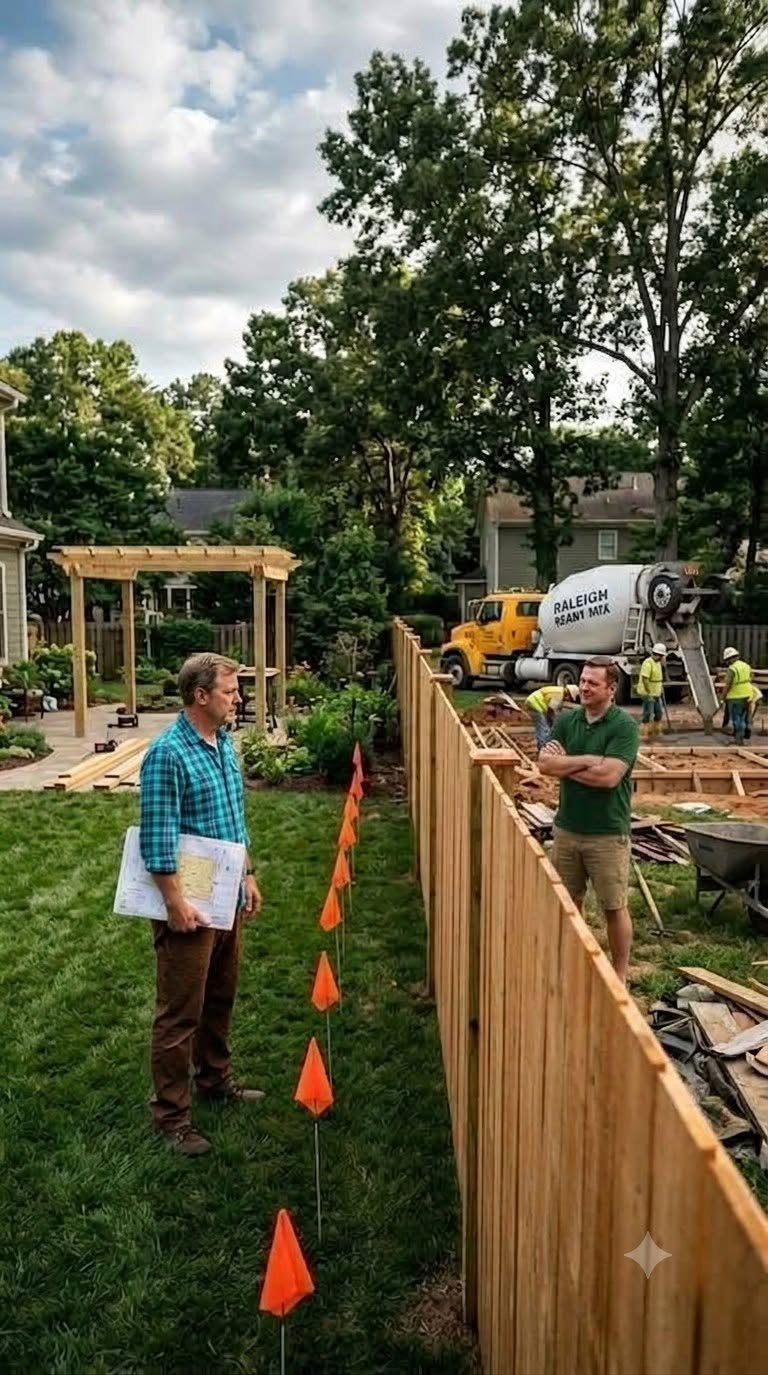
The fence line had been deliberately positioned around the oak tree.
Not randomly.
It created a narrow corridor.
A path leading from Tyler's backyard toward my property.
A path that ended directly at the vault.
I finally understood.
Tyler hadn't wanted the entire eastern side because of the pool.
He wanted access.
* * *
That night, I installed additional security cameras.
At 1:42 a.m., one of them detected movement.
I woke up to an alert.
Someone was in my backyard.
I opened the camera feed.
A flashlight moved beneath the oak tree.
I called the police.
Then I grabbed a flashlight and stayed inside.
Two officers arrived within minutes.
They found a man kneeling beside the oak.
It wasn't Tyler.
It was Martin Cole.
But this time, he wasn't carrying a shovel.
He was carrying a metal case.
The officers arrested him for trespassing.
When I asked what he was doing, he refused to answer.
Then one officer opened the case.
Inside was a stack of old documents.
Original deeds.
Property maps.
And a sealed envelope.
The envelope had my name on it.
JASON MILLER.
I stared at it.
“How did you get this?”
Martin finally spoke.
“Tyler found it.”
“What does it say?”
“I don't know.”
“Then why were you here?”
Martin looked at me.
“Because Tyler told me to destroy it.”
My blood went cold.
“Why?”
Martin swallowed.
“Because if you read it…”
He looked toward the oak tree.
“…you'll discover that your house may not be the most valuable thing you own.”
I opened the envelope.
Inside was a letter dated 1978.
The first sentence made my hands shake.
To the future owner of Lot 17:
If you are reading this, Hawthorne never told you the truth.
I looked at Rachel.
Then I read the next line.
The land beneath your home contains an asset worth more than every property in this neighborhood combined.
And beneath that was a final warning:
Never allow anyone to open the vault.
I looked toward Tyler's house.
Then my phone rang.
Unknown number.
I answered.
A man's voice said:
“Jason Miller?”
“Yes.”
“You've found the letter.”
“Who are you?”
“My name doesn't matter.”
“What do you want?”
“The documents.”
“No.”
He laughed quietly.
“Then you should know something.”
“What?”
“Tyler Bennett was never the person we were worried about.”
I froze.
“Who are you?”
The voice became colder.
“The people who built that vault are still looking for what was left inside.”
Then the call ended.
I looked at Rachel.
She looked terrified.
Because the final page of the letter contained one handwritten sentence: