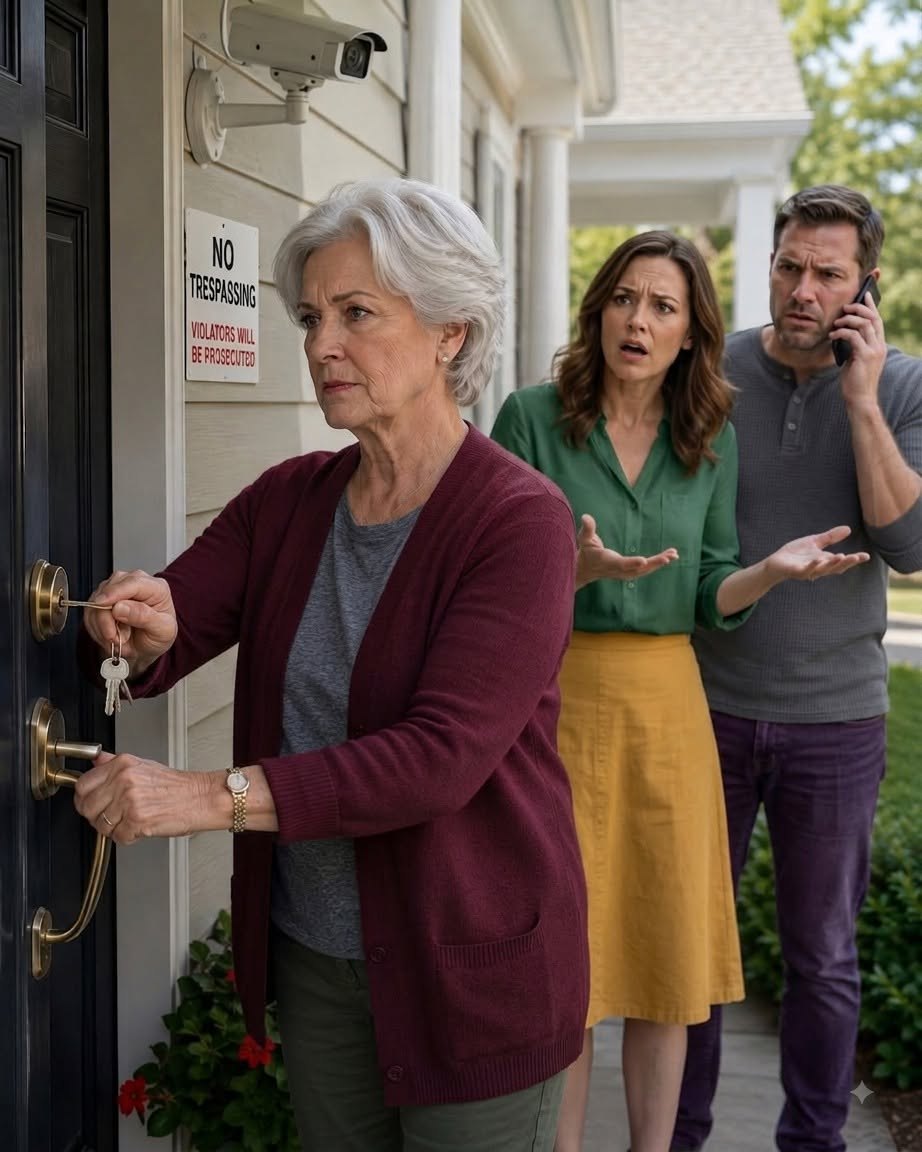
The morning I changed the locks on my house, I wasn’t trying to punish anyone.
I wasn’t angry. I wasn’t seeking revenge. And I certainly wasn’t trying to create a family war.
I was simply taking back something I had slowly allowed other people to take from me.
My peace.
For months, I had convinced myself that the little things didn’t matter.
The missing mail. The moved furniture. The thermostat that somehow never stayed at sixty-eight degrees. The groceries appearing in my pantry that I never bought. The quiet footsteps of someone entering my home while I was away.
I told myself I was being too sensitive.
After all, Sandra was my daughter-in-law. Gareth was my son.
Family was supposed to help each other.
But somewhere along the way, “help” had quietly transformed into control.
And I didn’t notice the difference until my own home started feeling like a place I needed permission to live in.
The first time I realized something was truly wrong was when I came home from grocery shopping and found my mail arranged perfectly on the hallway table.
Not where I always placed it.
Not where I had left it.
Someone had taken the time to organize it.
Bills stacked neatly. Magazines aligned. Letters placed according to size.
It looked innocent.
Almost thoughtful.
But there was something unsettling about seeing someone else’s hands quietly rearranging your life.
The next day, my thermostat was changed.
Seventy-two degrees.
I stared at the number on the screen for a long time.
It was such a small thing.
Most people would laugh.
But my husband Franklin and I had lived in this house for thirty-seven years. Every corner carried a memory. Every routine had a story behind it.
Sixty-eight degrees wasn’t just a temperature.
It was part of the life we built together.
Franklin always joked that I kept the house cold enough to preserve myself like a museum artifact.
I would laugh and tell him he was dramatic.
Now, after he was gone, those little habits became pieces of him that remained.
Pieces I wasn’t ready to give away.
Then came the slippers.
My blue slippers.
The ones I always kept beside my bed.
One evening, I found them perfectly placed in the hallway.
Straight. Parallel. Almost like someone was preparing the house for inspection.
That was when I stopped asking myself if I was becoming forgetful.
I wasn’t forgetting.
Someone was entering my home and making decisions as if it belonged to them.
Sandra and Gareth lived ten minutes away.
After Franklin passed, I gave them a spare key.
I told myself it was practical.
For emergencies.
A medical situation. A storm. A moment when I needed someone quickly.
I never gave them permission to walk in whenever they wanted.
I never gave them permission to redesign my kitchen.
I never gave them permission to slowly erase the evidence that this house was still mine.
Sandra always called it helping.
I called it crossing a line.
One morning, I returned from my walking group and found her standing in my kitchen.
No phone call. No warning. No knock.
She was unpacking groceries into my cabinets.
“My goodness, Mom,” she said with a smile. “You’re back already.”
I looked around.
My pantry had been rearranged.
My favorite foods had disappeared from their usual places.
Franklin’s favorite peanut butter was gone.
In its place were expensive jars of something I would never buy.
“I thought I’d make things healthier for you,” she said.
I placed my bag on the counter.
“Sandra, why are you in my house?”
She laughed softly.
“As if I need permission. I’m family.”
That sentence stayed with me.
Because people often use the word family when they want access they haven’t earned.
“I appreciate the thought,” I said carefully. “But I don’t want you changing my kitchen.”
Her smile faded slightly.
“I’m only trying to help.”
“I know.”
“Then why are you making this difficult?”
I looked directly at her.
“Because I didn’t ask for help.”
For the first time, she had no immediate answer.
She packed everything back into her bags and left.
But she didn’t leave understanding.
She left offended.
That evening, Gareth arrived.
I knew immediately why.
He wasn’t coming to check on his mother.
He was coming because his wife was upset.
He sat at my kitchen table, the same table where Franklin and I had celebrated birthdays, holidays, and ordinary Tuesday dinners.
“Mom,” he said with a tired sigh, “Sandra feels like you don’t appreciate what she does.”
I poured tea into two cups.
“Gareth, your wife entered my house without asking.”
“She has a key.”
“For emergencies.”
“What if something happened to you?”
“Then I would need help. Not someone rearranging my life.”
He looked around the room.
“It’s just a house.”
I placed my cup down.
“No.”
My voice surprised even me.
“It isn’t just a house.”
I looked toward the doorway where Franklin used to stand every morning.
“This is where your father repaired the old cabinet because he refused to buy a new one. This is where you learned to cook. This is where your sister cried after her first heartbreak. This house holds our life.”
Gareth looked uncomfortable.
But not because he understood.
Because he didn’t want to.
Finally, he whispered:
“She’s going to be hurt.”
And there it was.
Her feelings mattered.
Mine could wait.
That night, after he left, I opened my laptop.
For months, Gareth and Sandra had paid some of my bills.
At first, I believed it was love.
A son wanting to protect his mother.
But now I saw the truth.
Sometimes kindness comes with invisible strings attached.
I transferred every payment back into my own account.
Updated every password.
Changed every contact email.
Created a folder.
Household — Managed by Lindsey.
Because I wanted one thing clearly documented:
I was still capable of managing my own life.
The next morning, Sandra called.
“You changed the utility accounts?”
“Yes.”
“Why?”
“Because they’re mine.”
“We were helping you.”
“I appreciate what you did.”
A pause.
“But I don’t need it anymore.”
Her voice became colder.
“You’re being stubborn.”
“No.”
I looked around my quiet kitchen.
“I’m being independent.”
That was the moment I realized something.
The problem was never the spare key.
The spare key was only a symbol.
The real problem was that they had started believing my kindness meant they had ownership.
And that was something I could no longer allow.
Three days later, I saw Sandra’s car parked outside my house.
Beside her stood a contractor holding a clipboard.
Before she even reached the door, I knew.
She wasn’t visiting.
She was making plans.
Plans for my home.
Plans without me.
She smiled.
“Mom, don’t be upset. This is going to be a surprise.”
I looked at the man beside her.
Then back at Sandra.
“No.”
Her smile disappeared.
“No?”
“This isn’t happening.”
And that was when I made the decision that changed everything.
The next morning, I called a locksmith.
The sound of the drill echoed through every room.
Every turn of the lock felt like reclaiming a piece of myself.
When the new keys were placed in my hand, I felt something I hadn’t felt in months.
Freedom.
But changing the locks wasn’t the only thing I changed that day.
Because while Sandra was still convinced she could walk back into my house whenever she wanted…
I was preparing something that would make both her and my son realize one painful truth: