PART 2 — THE BOY THEY UNDERESTIMATED
Graham Whitmore stared at me as if I had just spoken another language.
For years, he had been surrounded by people who wanted something from him.
Investors wanted his approval.
Employees wanted promotions.
Partners wanted his signature.
Even friends admired the size of his bank account more than the person behind it.
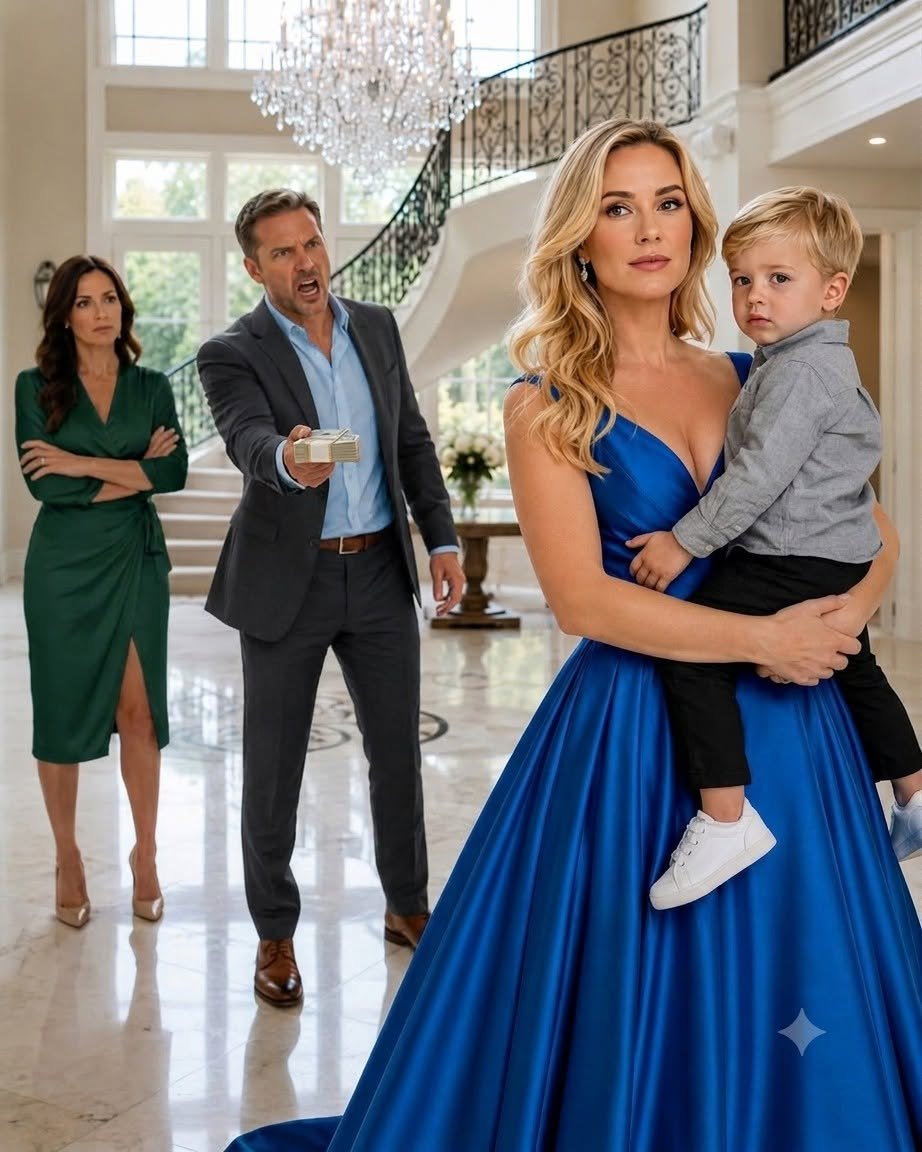
So when I pushed the $250 million divorce settlement back across the table, he couldn’t understand.
“You’re making a mistake,” he said.
His voice was calm, almost amused.
That was the thing about Graham.
He always believed he was the smartest person in every room.
He believed every problem had a price.
Every person had a weakness.
Every relationship could be negotiated.
But he had forgotten one important detail.
I was not negotiating anymore.
“No, Graham,” I replied.
“The mistake was believing you could lose your family and simply pay for a replacement.”
His expression changed for the first time.
Only slightly.
But I noticed.
Because after eleven years of marriage, I knew every version of his silence.
The silence before a business decision.
The silence before a lie.
And now…
The silence of a man who realized something was slipping beyond his control.
Behind me, Noah quietly left the kitchen.
I watched him go.
My heart broke seeing his small shoulders carry words no child should ever hear.
A father’s rejection.
A father’s disappointment.
A father telling him he wasn’t enough.
But what Graham didn’t know was that Noah had never been ordinary.
Not once.
When he was three years old, he repaired a broken clock because he wanted to understand “why time stopped.”
When he was five, he built a small robot from old electronics he found in the garage.
When he was six, he created a mathematical pattern that his teacher initially thought was a mistake.
It wasn’t.
It was something researchers spent months analyzing.
But Graham never saw any of that.
Because Graham never looked.
He only saw what he expected to see.
A quiet child.
A child who preferred books over sports.
A child who asked complicated questions at the wrong time.
A child who didn’t fit into the perfect image Graham wanted for his family.
To him, Noah wasn’t a son.
He was a flaw in the picture.
But three days earlier, everything changed.
I received the envelope while Graham was away on a business trip.
The return address made my hands shake.
The Whitmore family had always been wealthy.
But this was different.
This was from the International Center for Advanced Young Minds.
An organization that rarely contacted families directly.
I opened the envelope slowly.
Inside was a letter.
Not just an invitation.
A recognition.
Noah had been selected for a private evaluation program designed for children with extraordinary abilities.
The letter contained one sentence that I read over and over.
“Your son demonstrates a level of creative intelligence rarely observed in children his age.”
I remember sitting at the kitchen table crying.
Not because I was surprised.
I had always known Noah was special.
I cried because someone finally saw what I had been seeing all along.
Someone finally looked beyond the quiet boy sitting in the corner.
Someone finally understood.
That night, I walked into Noah’s room.
He was surrounded by notebooks.
Pages filled with drawings, equations, and ideas.
“Mom?” he asked.
“Did I do something wrong?”
The question shattered me.
Because a seven-year-old boy shouldn’t wonder if being himself was a mistake.
I sat beside him.
“Noah, why would you think that?”
He looked down.
“Dad says I’m not like other kids.”
I held his hand.
“You’re right.”
His eyes became worried.
“You’re not like other kids.”
I smiled.
“You’re you.”
And for the first time in months, he smiled back.
But I never imagined that a few days later, Graham would say those cruel words himself.
Now, standing in that kitchen, I knew something.
I wasn’t going to hide Noah’s achievements from him.
I wasn’t going to protect Graham’s reputation anymore.
The world deserved to know the truth.
Especially the people who spent years praising Graham Whitmore as a genius.
Because soon they would meet the person he failed to recognize.
His own son.
Graham picked up the divorce papers again.
“You really think some academic program changes anything?”
I looked at him.
“No.”
I walked toward the door.
“Your son changes everything.”
He laughed.
A cold, confident laugh.
“You’re still living in a fantasy.”
Maybe years ago, those words would have hurt me.
But not anymore.
Because the person standing in front of me wasn’t the man I married.
The man I married believed family was his greatest achievement.
The man standing there believed family was his greatest inconvenience.
As I reached the doorway, Graham called after me.
“You’ll come back.”
I stopped.
Not because I believed him.
Because I wanted him to hear my answer.
“Graham, the only thing I’m coming back for…”
I turned around.
“Is the day you finally understand what you lost.”
Then I walked upstairs to Noah’s room.
I found him sitting beside his desk, staring at his unfinished invention.
A small machine built from recycled parts.
“What is it?” I asked.
He looked nervous.
“It’s nothing.”
I smiled.
“Noah, I learned something about brilliant people.”
He looked at me.
“They often think their ideas are nothing before the world realizes they’re something.”
He touched the machine carefully.
“I wanted to show Dad.”
Those four words hurt more than anything.
Because even after everything…
Noah still wanted his father’s approval.
I hugged him.
And I made a promise.
Not to destroy Graham.
Not to take revenge.
But to make sure Noah never again believed he was less than anyone else.
The next morning, the invitation arrived officially.
The evaluation would take place in one week.
And among the names of the scientists attending was someone Graham Whitmore knew very well.
Someone who had once told the world that Graham was the greatest business mind of his generation.
Someone who would soon discover that the true genius had been living quietly inside Graham’s own home.
And when that day came…
Graham wouldn’t lose a business deal.
He wouldn’t lose money.
He would lose something much harder to recover.
The respect of the world.
And the love of the son he never bothered to understand.