My Sister Mocked Me: “YOU’RE REALLY WEARING THAT RAGGED UNIFORM TO THE WEDDING?”
But when I stepped into the aisle wearing four stars instead of lace, my father looked away.
Then the doors opened.
And the sound of 500 hands snapping to attention silenced my sister for the first time in twenty years.
My family’s jaws dropped.
Who was the outcast now?
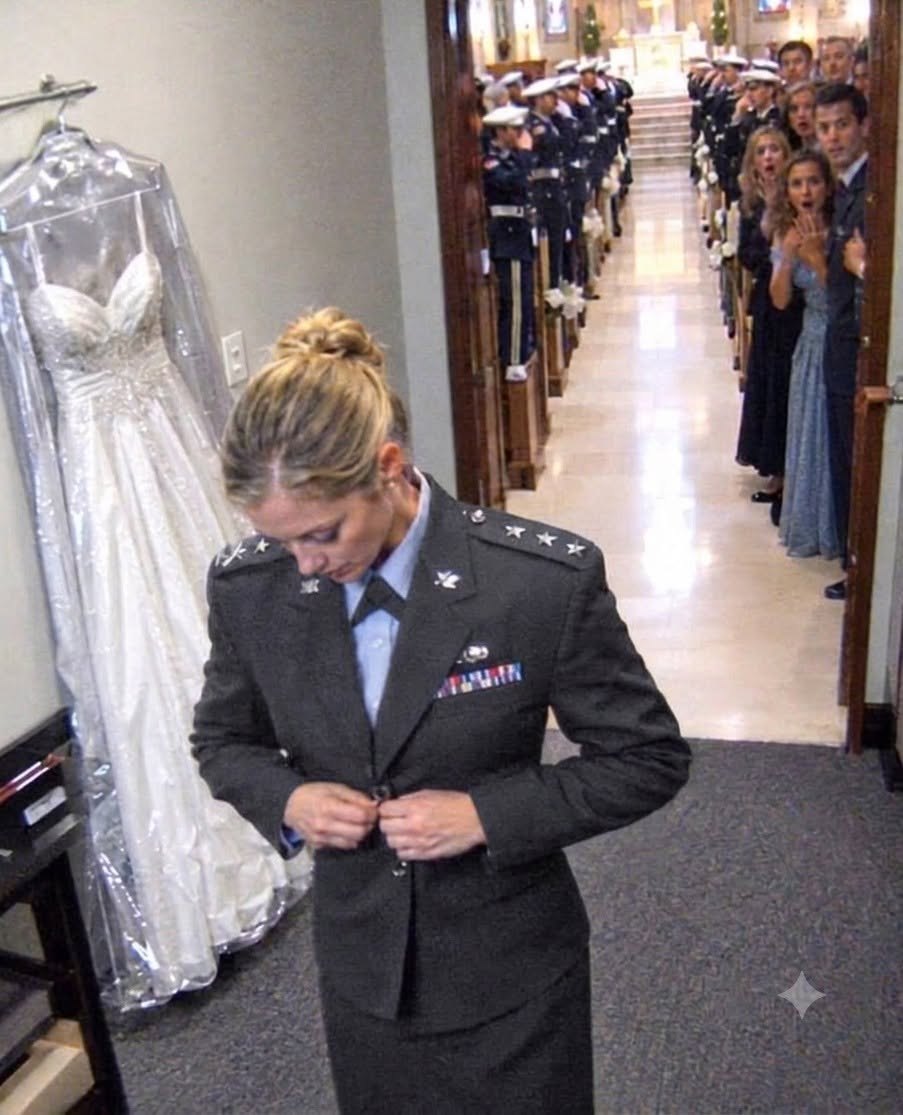
The morning of my wedding, I stood alone in a dressing room that smelled of lemon polish and dying flowers, fastening the buttons of a uniform that somehow felt heavier than body armor.
Beyond the door came the soft rustle of silk, whispered conversations, and the impatient click of my mother’s heels against the marble floor.
A white satin gown hung nearby inside a plastic garment bag.
My mother had sent it two weeks earlier.
No note.
No explanation.
Just a dress.
A silent prayer that, somehow, I might still become the daughter they wanted.
I ignored it.
Instead, I ran my thumb across the four silver stars resting on my shoulders.
The midnight-blue wool was warm against my skin. The blood-red stripe caught the light.
This wasn’t a costume.
It wasn’t a statement.
It was who I had become.
The door opened without a knock.
My sister, Saraphina, swept inside in a cloud of expensive white flowers and perfume. She took one look at me, then at the uniform, and her perfectly polished expression fractured.
“Oh my God.”
She stared at me as though I had committed some unforgivable social offense.
“You actually went through with it.”
I met her eyes through the mirror.
My hands were steadier now than they had been while holding a rifle in Fallujah.
“Good morning, Saraphina.”
She stepped closer.
Close enough for me to see the tiny vein pulsing at her temple.
“You’re seriously wearing that ragged outfit to your own wedding?”
Her voice dripped with contempt.
“You couldn’t just be normal for one day?”
She gestured toward my uniform.
“Wearing that thing is basically admitting you’re not woman enough for a real dress.”
Behind her, my mother released a small, distressed sigh—the same sound she made whenever a waiter brought the wrong wine.
“Tenna, sweetheart…”
Her voice softened into that carefully rehearsed tone she always used when she was ashamed of me.
“There’s still time. We can help you change.”
She glanced nervously toward the door.
“There are defense contractors here. Important people. People your father knows.”
My father stood silently in the corner.
His jaw tightened as he stared at the stars on my collar.
Not with pride.
With embarrassment.
“It’s a wedding,” he finally said. “Not a command performance.”
Something inside my chest went cold.
It was an old feeling.
A familiar one.
I had known it since I was ten, when my father told me I threw a baseball “too hard.”
I had felt it at prom, when my mother said my shoulders were “too broad” for a strapless dress.
And I felt it now.
Because apparently, even after everything I had accomplished, they still wanted to cut pieces of me away until I fit neatly into the photograph they had imagined.
I glanced at the white gown.
It was beautiful.
But it wasn’t me.
It was simply a prettier version of the daughter they wished they had.
Saraphina noticed the hesitation in my eyes.
Her smile widened.
Then she leaned toward me.
“Without those stars,” she whispered, “what are you, exactly?”
Before I could answer, someone knocked.
Three sharp knocks.
Firm.
Precise.
Not the hesitant tap of a family member.
Master Sergeant Diaz entered.
His dress blues were immaculate. His posture was rigid, his expression carved from stone.
But his eyes softened when he saw me.
“Ma’am.”
He gave a crisp salute.
“They’re ready.”
I frowned.
“Who’s ready?”
Sergeant Rocco appeared behind him, barely concealing a smile.
“You should see this for yourself, General.”
Saraphina rolled her eyes.
“Oh, please.”
She folded her arms.
“What now? Your own little fan club of jarheads?”
I said nothing.
I simply walked past her.
Into the narthex.
The atmosphere changed immediately.
The air felt colder.
Heavier.
The murmuring voices beyond the chapel doors faded.
Not gradually.
All at once.
Silence.
I stepped through the archway.
And stopped.
The pews were filled with civilians—analysts, contractors, executives, politicians.
The very people my mother cared about impressing.
But the walls surrounding them were lined with midnight blue.
Five hundred Marines.
Standing shoulder to shoulder.
Dress blues pressed so sharply they looked as though they had been cut from the night sky.
Some faces were young.
Others carried the quiet weight of decades.
I recognized many of them.
Men and women I had led in Iraq.
People I had watched bleed.
People I had watched cry behind motor pools.
People who had trusted me when everything else had fallen apart.
Some wore Bronze Stars.
Some carried scars no medal could explain.
And then, from the front row, a gravelly voice thundered through the chapel.
“GENERAL ON DECK!”
The sound that followed wasn’t a gasp.
It was a crack of thunder.
Five hundred heels struck the floor in perfect unison.
One thunderclap.
Five hundred Marines.
Five hundred years of discipline seemed to echo through that single sound.
Then, in one fluid movement, five hundred right hands rose to the brims of five hundred covers.
A sea of white gloves.
A wall of blue.
A salute so precise it seemed almost unreal.
Behind me, my family made a sound I will remember for the rest of my life.
The sound of five people suddenly realizing they had completely misunderstood who I was.
I didn’t turn around.
I didn’t need to.
I looked toward the altar.
Julian was standing there, staring at me with a grin that said he had just won the lottery.
And behind him stood the people who had followed me into places where most people would never dare to go.
Saraphina’s question echoed inside my mind.
*Without those stars, what are you, exactly?*
I finally knew the answer.
I was not the daughter they were ashamed of.
I was not the sister they could mock.
I was not the woman who needed their approval.
Standing beneath five hundred salutes, I understood something I had spent twenty years trying to learn.
I had never been the outcast.
I had simply been the only one in my family brave enough to become myself.
And for the first time in my life…
I was home.