PART 1 — “Grandma… Mom Says Don’t Let Them Burn Her.”
At my daughter’s funeral, my seven-year-old granddaughter squeezed my hand so tightly that her fingernails dug into my skin.
“Grandma…”
Her voice trembled.
“Mom says… don’t let them burn her.”
For a moment, I forgot how to breathe.
In front of us lay the open coffin of my daughter, Mariana.
She was only thirty-five.
Beside the coffin stood my son-in-law, Cristóbal, dressed in an immaculate black suit, accepting condolences with precisely the expression everyone expected from a grieving husband.
Head lowered.
Eyes red.
Voice barely above a whisper.
A perfect performance.
But I had spent thirty years working as an emergency nurse.
I had watched people grieve.
I had watched people pretend to grieve.
And I knew the difference.
That wasn't grief.
It was acting.
Mariana had died two days earlier.
According to Cristóbal, she had collapsed in the bathroom of their home and suffered what appeared to be sudden cardiac arrest.
By the time I reached the private hospital, he had already spoken to the doctors, contacted the funeral home, arranged the service, and even spoken with the priest.
Everything had been decided.
There would be no autopsy.
The funeral would take place immediately.
And her body would be cremated the same day.
“It was what Mariana wanted,” Cristóbal had told me when I confronted him.
“My daughter never told me she wanted to be cremated.”
For the briefest fraction of a second, something flickered across his face.
Then the mask returned.
“Teresa, you're in shock. Please don't make this harder than it already is.”
That sentence stayed with me.
Not because it was cruel.
Because it sounded rehearsed.
Mariana had been healthy.
She ran three times a week.
She didn't smoke.
She had no serious cardiac history.
Less than a month earlier, she'd undergone a routine medical examination.
Everything had been normal.
Of course, healthy people could die unexpectedly.
I knew that better than anyone.
But after three decades in emergency medicine, I had learned to trust the quiet warning that sometimes came before the evidence.
And something inside me was screaming:
Stop the cremation.
Then there was Veronica.
My granddaughter had always been an unusually perceptive child.
Since she was little, she sometimes said things she couldn't possibly have known.
Once, she had asked about a distant relative on the exact day something had happened to him.
Another time, she had woken from a nightmare and insisted that someone was crying.
I had never encouraged those ideas.
Children processed grief in strange ways.
That was what I told myself.
Until the drive to the funeral home.
Veronica had suddenly begun breathing rapidly in the back seat.
“Grandma…”
I glanced at her through the mirror.
“What is it?”
“Mom is in the back seat.”
My hands tightened around the steering wheel.
“What did you say?”
She turned toward the empty space behind her.
“She’s crying.”
I nearly lost control of the car.
“Veronica, sweetheart, Mommy isn't—”
“She says nobody is listening to her.”
I swallowed hard.
I told myself it was grief.
A seven-year-old girl had lost her mother.
Her mind was desperately searching for a way to make sense of something it couldn't understand.
But now, in the middle of the funeral ceremony, Veronica began trembling again.
“Grandma…”
I leaned closer.
“What is it?”
“Mom is screaming.”
“Veronica…”
“She says he's lying.”
My eyes lifted toward the other side of the aisle.
Cristóbal was watching us.
Not the priest.
Not the coffin.
Us.
“What else is Mommy saying?” I whispered.
Veronica swallowed.
Then she pointed toward the coffin.
“She says…”
Her voice broke.
“Look under her dress.”
Cristóbal stood immediately.
He must have seen something in my expression because he began walking toward us.
“Teresa,” he said quietly, “I think you should take Veronica outside for a moment.”
“Why?”
“She’s distressed.”
Veronica grabbed my sleeve.
“Grandma…”
Then she whispered the words that changed everything.
“Mom says he's going to burn the evidence.”
Cristóbal went pale.
Not dramatically.
Not enough for anyone else to notice.
But I noticed.
I had spent thirty years watching faces in emergency rooms.
I knew what fear looked like.
And that was fear.
I stood.
The chair legs scraped loudly against the floor.
More than a hundred people turned toward me.
The priest stopped speaking.
“Teresa,” Cristóbal hissed through clenched teeth. “Don't make a scene.”
I took Veronica's hand.
“I'm not making a scene.”
I looked directly at him.
“I'm saying goodbye to my daughter.”
“You already said goodbye.”
“Move.”
His jaw tightened.
“You're not thinking clearly.”
Two security employees began approaching.
I reached into my handbag and took out my phone.
Hours earlier, before entering the funeral home, I had sent a message to Diego Herrera, an investigative commander and an old friend of my late husband.
His reply had been short.
“Do not allow Mariana to be cremated until I tell you otherwise.”
I didn't know what Diego had discovered.
I didn't know whether he could legally stop the cremation.
But I knew one thing.
I needed time.
Cristóbal suddenly reached for my arm.
“Enough.”
I pulled away.
“Don't touch me.”
The entire room fell silent.
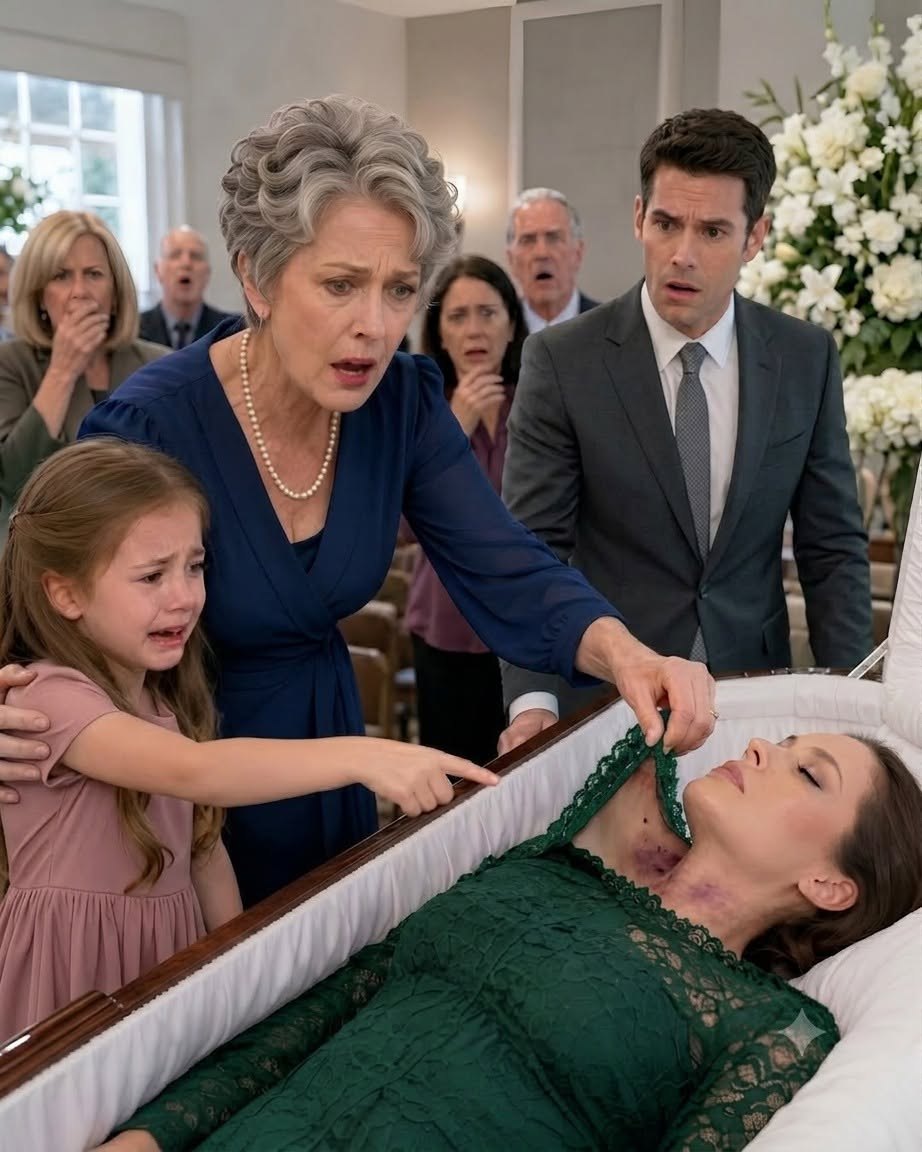
I walked toward the coffin.
Mariana had been dressed in an elegant black dress with a high lace collar.
I stared at it.
Something felt wrong.
My daughter hated high collars.
She always said they made her feel like she couldn't breathe.
I looked at Cristóbal.
He wasn't pretending anymore.
He looked terrified.
“Don't touch her,” he said.
I ignored him.
I placed my fingers beneath the lace.
Then I pulled the collar down.
A woman gasped.
Someone else screamed.
And I stopped breathing.
Beneath the funeral home's careful makeup, partially concealed by the lace, were dark, unmistakable marks circling my daughter's throat.
Bruises.
Finger-shaped.
Deep enough to tell a story.
I had seen marks like those countless times in emergency rooms.
They weren't consistent with a sudden cardiac arrest.
They weren't the aftermath of an ordinary collapse.
They were signs of violence.
Cristóbal stumbled backward.
For the first time since Mariana's death, the grieving husband disappeared completely.
There was only panic.
And suddenly, I understood.
I understood why he had rushed the funeral.
Why he had fought against an autopsy.
Why he had insisted on cremating her body before anyone could examine it properly.
He hadn't been trying to bury my daughter.
He had been trying to destroy the evidence.
And somewhere behind me, my granddaughter whispered:
“Grandma…”
I turned.
Veronica was staring at Cristóbal.
Her face had gone completely white.
“Mom says…”
She pointed directly at him.
“He didn't do it alone.”
And that was the moment the funeral stopped being a farewell.
It became a crime scene.